
September, for children it’s a chance to start their new working year refreshed and energised. As we wave them off to school with their shiny shoes and oversized blazers, is it time to ask ourselves whether WE need to click ‘refresh’ and set our intentions for how we want to work together going forwards?
Apple clearly think so, on 15/8/22 Chief Exec Tim Cook told employees they must return to the office at least 3 days per week from September, saying the move would “preserve the ‘in person’ collaboration that is so essential to our culture”

The much-debated topic of how we work together following our enforced lockdowns is one that’s been fascinating us for the last 18 months. For many who work in international teams, or for those who worked from home prior to lockdown there has been little noticeable change in the way we interact.
There are, however, some teams who have seen a huge change and are still struggling to find the rhythm that works best for them. GMs are left wondering how long they should keep paying for those square feet of office space that are left unoccupied for much of the week.
I guess we are fortunate to have a ‘birds-eye view’ working with different clients, all of whom are approaching their ‘new normal’ in a slightly different way. There doesn’t seem to be a ‘one size fits all” solution (and as I’ll suggest during this post, arguably there shouldn’t be).
Whilst leaders are busy debating the f2f vs remote vs hybrid options, employees’ confidence that we won’t ever return to a predominantly office based working environment seems high. There has been a surge in house prices in rural areas based on the demand from those ‘chasing the space’ after a re-evaluation of our life priorities during Covid.
Data from Nationwide Building Society (quoted in ‘Mortgage Strategy’- May 22) shows that house prices in rural areas have risen by 29% over the last 5 years, compared to an 18% increase in predominantly urban areas. They also say that 28% of people surveyed who had recently moved were moving to a different, less urban area.
A ‘Total Company’ mandate approach to re-integration?
So, is the approach taken by Apple to reintegrate the Organisation the only option? There are compelling arguments that mandating a couple of days per week face to face for the total company provides a sense of belonging, shared accountability, and builds stronger relationships, hence increasing performance.
I have seen a few organisations suggest two days office- based with varying levels of uptake even after a mandate from senior leadership. A ‘one day per week ‘anchor day’ approach has proved more successful for one of our clients.
There are some with the opinion that mandating office time discriminates against those less mobile, those who need to manage other commitments during the day and work more flexibly. The debate has been linked to gender equality and inclusivity. Reclaiming time in our pursuit to achieve more each day seems to be a huge factor in our choice of where to work and why many of us have settled on a routine of spending more time working from home.
Perhaps we simply find that we get more time to work by removing the commute time, the chats over the partitions, the shared lunch table. Our ability to incorporate some domestic tasks into our working day makes home life run more smoothly and means we get more ‘evening’ at the end of the day, more time with the family. Ironically, our Organisations also get more of our time as we struggle to navigate our boundaries with working hours and forget to leave our desks for lunch.
A healthy team dynamic is one that takes into account the whole teams needs.
‘Being out of the home each day is vital for their mental health…..’
So, what does this increase in flexibility and reduction in office time mean for team members if they don’t have as many relationships at home to manage, and as many dependents at home? What if ‘post lockdown’ they were relieved at the thought of getting back to the office full time? For each of the benefits of remote working listed above, I can think of colleagues in each of our client organisations who live on their own, and for whom their face to face working relationships play a more significant role in their life.
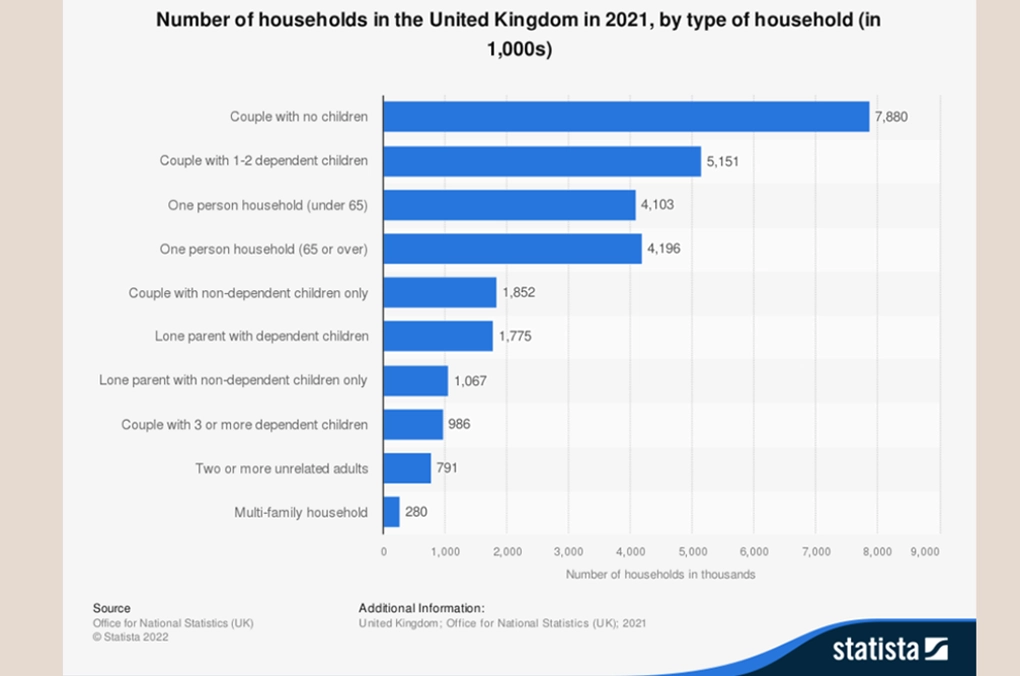
Although it may seem as if couples with children are the most common family structure in society, statistics show us otherwise. In the UK, the greatest proportion of households are couples who don’t have children. Couples with children make up 18% of households in the survey whilst people living on their own under 65 constitute 14.5%.
If we were to add together all households with people living on their own, lone parents and those living in households of unrelated adults (all the groups not classified as couples) then that number increases to 42% of households. Statistically then, it’s likely we have a mixture of different household types in our Organisations and individual teams.
Some of the conversations I’ve had over the last year have reminded me that many people rely on the change of scene that travelling to the office brings, enjoy the distinction between weekday and weekend location, the social aspect of office life. A few of these people I’ve spoken to, still come to the office most days to provide this distinction between home and work regardless of how few people are in the office. It may not provide the social outlet that it used to, but it’s still preferable to staying at home, as being out of the home during the day is vital for their mental health.
A team led approach to re-integration?
”So, like everything else in our post pandemic world, we have to be increasingly agile, adapting to change at a far greater pace than ever before, and open to new creative ways of working”
So, what have our observations at Inspiros taught us about how to achieve the healthiest possible team dynamic in our post pandemic world? Well, perhaps that “one size fits all” is more damaging than helpful regardless of whether we are trying to make people fit the f2f, hybrid or remote model. Are we providing a false sense of fairness and equity for employees if what works so well for some to provide additional flexibility leaves others feeling isolated if they don’t fit into the stereotype of ‘always wanting more time at home’ (would you feel confident enough if you were the one person in your team without partner and children to ask your colleagues to hang out in the office more ? I’m not sure I would!)
As consultants, we can’t tell your Organisation or your team which way of working is the best for you and your team members, but we CAN say with confidence that you need to hashtag#starttheconversation about what works for all of you. In essence, the only team dynamic that will get the best out of your team, leaving them fulfilled and motivated is one that works for ALL of the people who are part of your team at that point in time. You need to agree upon your team communication, how you feel best connected, the proportion of f2f time vs remote that will achieve this and find a pattern that works for every member of your team including those without children and partners. So, like everything else in our post pandemic world, we have to be increasingly agile, adapting to change at a far greater pace than ever before, and open to new creative ways of working.
Working remotely doesn’t always have to mean working ‘from home’, it could mean a team meeting at someone’s house or a walking meeting. Socialising with your team can still happen face to face in the evenings as it would previously. Office based time doesn’t have to be 9-5, it could be 10-3 with a flexible approach to managing your hours during the week but you still get the time some face-to-face interaction.
Start the conversation today with your team

Are you ready to challenge your beliefs and get out of your comfort zone when discussing your team’s needs? Do you all have the right level of trust and communication to experiment with new ways of working? Do you have the confidence and psychological safety to speak up if you aren’t feeling engaged and integrated with current ways of working?
Crucially, if you aren’t sure whether somebody’s current level of face-to-face interaction with colleagues is benefiting them, their performance, motivation or mental health…. #starttheconversation by asking them today. It’s likely they may not feel able to speak up about not feeling as much a part of the team.
Perhaps then, another way to re-connect and reintegrate total organisations could be to start with a collection of happy healthy teams?
Recent Comments